Rebecca Wallersteiner visits the fascinating, interactive Bodyworlds: The Anatomy of Happiness exhibition in South Kensington, London until 21st March 2027 that replaces standard textbook diagrams with real, donated human bodies and organs to explore the relationship between happiness, physical health and the human body.
If, like me, you’ve ever wondered what exactly an enlarged prostate, mitral or tricuspid valve, cancer tumour or gall stones look like, then don’t miss seeing a fascinating and educational new exhibition in South Kensington until 21st March 2027. Bodyworlds: The Anatomy of Happiness replaces boring textbook diagrams with real donated human bodies and organs, frozen mid-movement, to explore the relationship between happiness, physical health and the human body. These human specimens have been preserved through plastination, a process invented by scientist Dr Gunther von Hagens in 1977 that replaces bodily fluids and soluble fats with reactive plastics to make anatomy accessible to all.
Healthy and diseased organs are placed side by side, including a brain affected by Alzheimer’s, a brain slice showing stroke haemorrhage, and smoker and non-smoker lungs. Dr Angelina Whalley, the curator of the exhibition comments: ‘Through plastination we are able to present the human body in a memorable and beautiful way, allowing people to learn about anatomy, disease and health in a direct and deeply personal manner. With The Anatomy of Happiness, I want to show that our body is not only the basis of life, but also the place where our experiences, emotions and choices leave their traces’.
All the human bodies and organs on display have been generously donated by people as a contribution to science. It was fascinating, educational and slightly unnerving to walk around and see them. ‘Many visitors leave Bodyworlds with a new awareness of their own body and a new motivation to live more consciously,’ said Whalley.
Two memorable exhibits on display are a smoker’s lung juxtaposed with a non-smokers lung. Although the smoker puffed only twenty cigarettes a day the lungs are dark grey. To emphasise this they are shown next to a full glass of black cigarette tar and soot particles from smoke formed by deposits in the pulmonary tissue turning it black. Thankfully I have never smoked, but it made me wonder what the artist David Hockney’s lungs looked like when he recently died having defiantly smoked 25 cigarettes a day over 65 years. Despite this, he famously outlived four of his doctors and kept an emergency supply of 2,000 cigarettes at his home.
The exhibition shows how the extraordinarily complex human body works, from the heart, brain, kidneys and liver to reproductive organs and how foetuses develop.
I particularly enjoyed the highly educational, interactive installation instructing the visitor how to give CPR in case of drowning, heart attack, or when someone has stopped breathing, performing on two lifelike dummies. Learning this could save a life one day as CPR can keep oxygenated blood flowing to the brain and other vital organs until an ambulance with more definite medical treatment arrives to restore a normal heartbeat. The show also provides devices to enable visitors to measure their own blood pressure and also charts to interpret which results are in the normal range and which are not.
The Anatomy of Happiness examines the link between physical health and emotional wellbeing and how negative emotions including stress, loneliness, anxiety and everyday lifestyle choices can affect the body and mind. It looks at how the brain, cardiovascular and respiratory systems respond to our everyday activities.
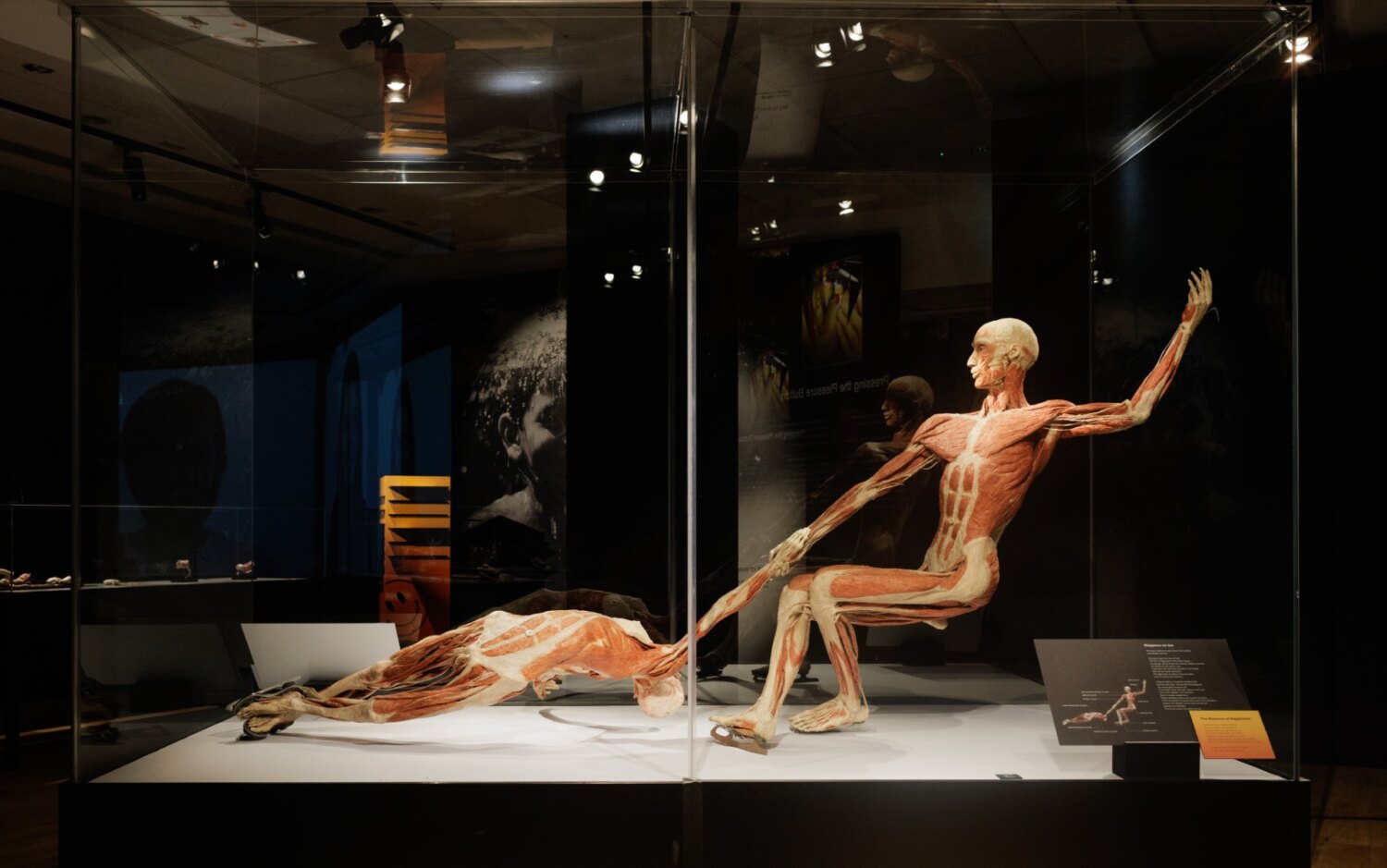
One striking full-body plastinate is posed like a skateboarder twisting skilfully with his board, allowing the viewer to see how the muscles, tendons and skeleton frame move in motion. In another exhibit entitled Elegance on Ice, two skater plastinates are gracefully entwined, their honed muscles frozen in time.
Other exhibits feature a skeleton showing spinal degeneration and 3D body slices, including a brain slice showing haemorrhage following a stroke.
A series of documentary photo series on centenarians explores longevity and healthy ageing. Most of the centenarians pictured undertook regular exercise that had many benefits, including strengthening muscles and bones, and keeping joints flexible. Movement can also help lift mood, whether taking a walk, cycling or dancing. All exercise helps release feel-good chemicals in the brain. Stress and anger often fade and our mood improves and we feel more balanced.
Everything on display comes from people who generously chose to donate their bodies for the plastination programme.
At the end of the exhibition I knew a lot more about how the human body works and resolved to be kinder to my own body, try to avoid stress, cut down on crisps and biscuits, spend more time with friends and get more sleep.
If you are wondering what to do at half-term, or at the weekend this winter, this exhibition is fun and entertaining, as well as being highly educational. It would be suitable for anyone who works in health, teenagers interested in pursuing a future career in science, or medicine, but definitely not recommended for anyone squeamish.
Don’t miss seeing the film at the end of exhibition on how plastination is done. Each body takes around a year to plastinate.
You’ll never look at yourself in the mirror the same way again!
Tickets for Bodyworlds: The Anatomy of Happiness until 21st March 2027, are available across a range of price points, with adult tickets starting from £18.50, senior and student tickets from £14, and tickets for young people aged 6–17 from £11. Group rates will also be available, including discounted rates for larger and educational groups.
Exhibition venue: Sussex Mansions, 79–85 Old Brompton Road, London SW7 3LD
Opening hours: Monday and Sunday: 10:00 AM – 6:00 PM; Tuesday to Thursday: 10:00 AM – 7:00 PM; Friday and Saturday: 10:00 AM – 8:00 PM

- Body Worlds Exhibition - November 6, 2026
- The Sightsavers Garden at Chelsea Flower Show - May 22, 2026
- “My Head is a Fairground” - April 24, 2026